🔥2026 STEAKout Sale + FREE Raw Milk!
100% Grassfed | 100% Clean | 100% Delicious
Shop Sale Now!

Raw Milk FAQ's

written by

Corbin Steiner

posted on

July 13, 2024

Good morning! 

Raw milk is one of the most popular products that we sell! We're currently at around 265 families that are subscribers and there are new people showing up to buy our milk every week!🥛🙋‍♀️

With all this excitement around our milk, I thought it would be nice to share some info on what makes raw milk so healthy, the safety of raw milk (including recent bird flu misinformation), and also answer some common questions! 

What Makes Raw Milk So Healthy?

Pasteurized milk is heated to high temperatures to kill any bacteria or pathogens and most is also homogenized by forcing it through tiny holes at high pressure to break apart the cream molecules so the cream doesn't rise to the top.

The problem is that these processes alter the milk proteins and make it hard for our bodies to recognize! I believe this is a major contributor to why so many people have lactose intolerance! Interestingly, surveys have shown that around 80% of people that are lactose intolerant can handle raw milk just fine and many of our customers have found this to be true!!!

This chart says a lot!
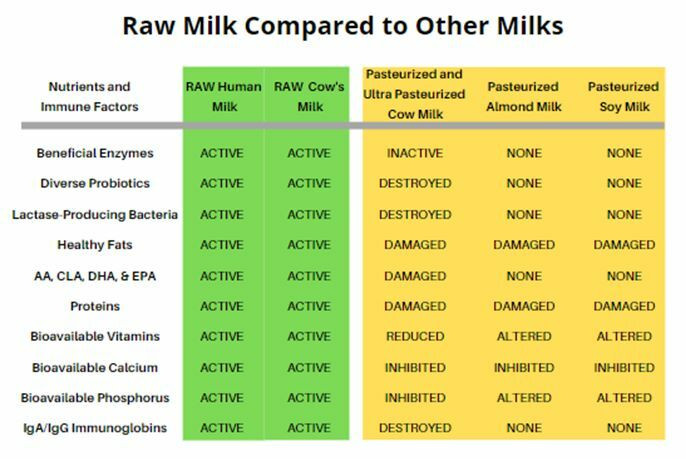
Raw-milk-chart.jpg

(used by permission from RAWMI)

Raw milk has a wide array of essential nutrients, fats, proteins, anti-inflammatory and digestive enzymes, bioavailable vitamins, and minerals that are easily utilized by the body because they are in their natural form!

Drinking raw milk has been shown to lower rates of ear infections, runny noses, fevers, and respiratory infections and it even reduces allergies like asthma, allergies, eczema!

I love hearing our customers share how this super food has helped them in their health journey in ways similar to these testimonials!

Is Raw Milk Safe?

It depends on who you ask! According to some institutions, raw milk is dangerous and should be banned from being sold! But there may be more to the story...

According to the article "Two Types of Raw Milk" from the Raw Milk Institute (RAWMI):
 
"It is important to note that there is no such thing as a perfectly safe food. An analysis of foodborne illnesses from 2009-2015 showed that the top food categories commonly linked to illnesses were chicken, pork, and seeded vegetables. Pasteurized milk is not perfectly safe, either, and is implicated in foodborne illnesses and outbreaks every year.  The CDC outbreak and illness data which is used to assert that raw milk is unsafe does not distinguish raw milk intended for pasteurization from raw milk that is carefully produced and intended for direct human consumption."

Quoting from RAWMI again:
"Recently, researchers from Canada and Europe have studied the safety of raw milk intended for direct human consumption. They have found that carefully produced raw milk is a low-risk food which is fundamentally different from pre-pasteurized milk."

What About Bird Flu in Dairy Cattle?

Raw-milk-and-bird-flu.jpg

(used by permission from RAWMI)

Concerns over the avian influenza being found in dairy cattle have been in the news the past several months, with several health agencies recommending that people don't drink raw milk because of the possibility of the virus transmitting to humans through raw milk.

When a customer asked me early on what I thought, my response was that "My general feeling is that healthy animals being raised in their natural environment on pasture with fresh air and sunshine rather than in confinement are going to be a lot less susceptible to disease! But, that's not to say that we couldn't ever have an issue."

As more info has come in I've become even less concerned about the bird flu in dairy cattle and view it more as a scare tactic.

According to RAWMI, "Recent risk communications from CDC , FDA, and USDA regarding transmission of influenza A sub-type H5N1 (highly pathogenic avian influenza virus or HPAI) to humans via raw milk include no supporting evidence of viral transmission from raw milk to humans in the peer-reviewed literature.
 
 CDC and USDA reported that the HPAI strains recently isolated in the US lack the genetic markers for viruses adapted to infect humans. An extensive body of scientific evidence from the peer-reviewed literature introduced herein does not support the assumption by these US government agencies that HPAI transmits to humans via milkborne or foodborne routes and causes disease. Nor does the scientific evidence support the recommendation that consumers should avoid raw milk and raw milk products."


You can read the full article from RAWMI and also another article from realmilk. com that gives more information on this topic including talking about the antiviral properties of raw milk.

Should I drink raw milk when I'm pregnant?

Once again, you'll have to decide who to believe! Personally,I choose to stick with what humans have done for thousands of years vs. the health ideas of the last century and the declining health that has resulted!

The Weston A. Price Foundation studies traditional cultures around the world to see what makes them so much healthier than western civilization. Their recommendation for pregnant and nursing mothers is to drink 1 quart of whole raw pasture-fed milk per day! They mention that "Folate from raw milk is accompanied by a protein that doubles its absorption." Their recommendations for mothers also include other nutrient dense foods like liver, egg yolks, and cod liver oil.

Another thing to note is that if you are unable to breastfeed your baby, Weston A. Price has a raw milk baby formula recipe that is much healthier than boughten formula!

Should I give my toddler raw milk?

ABSOLUTELY! My two daughters LOVE our raw milk! Like was mentioned at the top, including raw milk in your child's diet is shown to lower rates of ear infections, runny noses, fevers, and respiratory infections and it even reduces allergies like asthma, allergies, and eczema!

Growing children need lots of high quality nutrients, and that is just what raw milk has to offer!

So, how about you? Are you excited because you've experienced improved health from drinking raw milk? If you have I'd love to hear about it!

I welcome any feedback and also feel free to send questions my way as well!

Have a blessed weekend!

~ Corbin
 
 Prairie Creek Pastures

Corbin-Head-shot-150px.jpg

More from the blog

The Ultimate Grassfed Steak Buying Guide

There’s nothing quite like a great steak cooked over a hot grill or cast-iron skillet. But with so many cuts to choose from, it can be hard to know which steak is right for your family, cooking style, or budget. Here at Prairie Creek Pastures, our cattle are 100% grass-fed and grass-finished and raised on regenerative pastures without hormones, antibiotics, or vaccines. That means every cut delivers clean flavor, nutrient-dense nutrition, and the kind of quality you can feel good about feeding your family. This guide walks through the steaks we offer and helps you understand what makes each one unique — from rich, buttery ribeyes to lean and flavorful sirloins. Quick Tip: Grassfed beef cooks faster than conventional beef. For the best results, cook most steaks to medium-rare or medium (internal temp 130-135°) and allow to rest at least 5 minutes before slicing. (see notes at bottom) Choosing the Right Steak When picking a steak, most people care about four things: Flavor Tenderness Marbling Value Some cuts excel in one area, while others strike a balance across all four. Filet Mignon The Most Tender Cut Filet mignon is known for one thing above all else: tenderness. Cut from the tenderloin, this steak has very little connective tissue, giving it an exceptionally soft texture. What to Expect Extremely tender Lean and delicate Mild beef flavor Smaller portion size Best Cooking Method Cook carefully over high heat and avoid overcooking. Because filet is lean, medium-rare is ideal. Cost: $$$ Great For Date nights Elegant dinners Anyone prioritizing tenderness Ribeye Steak The Classic Steakhouse Favorite The ribeye is prized for its rich marbling and bold flavor. Cut from the rib section, this steak delivers the most traditional steakhouse experience and is often the first choice for serious steak lovers. What to Expect  Rich, juicy flavor Excellent marbling Tender texture Best for grilling or cast iron searing Best Cooking Method Sear over high heat and finish at a more moderate temp. A simple seasoning of salt and pepper is often all you need. Cost: $$ Great For Special occasions Reverse searing Grill enthusiasts NY Strip Steak Best All-Around Steak  The New York Strip is a favorite for people who want a steak that balances tenderness with a firmer, beefier bite. It is a dependable steak that is easy to cook and hard to mess up. Compared to a ribeye, the strip steak is slightly leaner but still offers excellent flavor and a satisfying texture. What to Expect Bold beef flavor Moderate marbling Tender with a slight chew Consistent cooking results Best Cooking Method Excellent on the grill or pan-seared with butter and herbs. Cost: $$ Great For Weeknight steaks Steak sandwiches First-time grass-fed buyers Top Sirloin Steak Lean, Affordable, and Versatile Top sirloin is one of the best everyday steaks because it delivers great flavor at a more affordable price point. It’s leaner than ribeye or ny strip steak but still tender when cooked correctly. What to Expect Lean and hearty Great beef flavor Excellent value Easy to cook Best Cooking Method Grill or pan-sear to medium-rare and slice against the grain. Cost: $ Great For Family dinners Meal prep Steak salads and bowls Flat Iron Steak One of the Best Values in Beef Flat iron steak combines tenderness, marbling, and affordability in one underrated cut. It’s cut from the shoulder and offers excellent flavor without the premium price tag of ribeye or filet. What to Expect Tender textureGreat marblingRich flavorExcellent value Best Cooking Method Perfect for cast iron or grilling. Cost: $ Great For Budget-friendly steak nightsSandwichesSlicing over salads Hanger Steak The Butcher’s Favorite Hanger steak is one of the most flavorful cuts on the animal and remains a hidden gem for many home cooks. It has deep beef flavor and a loose grain that absorbs marinades beautifully. What to Expect Intense beef flavor Tender when sliced correctly Loose texture Excellent for marinades Best Cooking Method Cook quickly over high heat and always slice against the grain. These can be difficult to cook evenly because it tapers from thick to thin, but utilizing cool/hot parts of the grill can solve that. Cost: $ Great For Steak tacos Fajitas Chimichurri-style preparations Flank Steak Lean and Full of Flavor Flank steak is a long, lean cut with incredible flavor. While it’s not as naturally tender as ribeye or filet, proper slicing makes all the difference. What to Expect Lean texture Strong beef flavor Best when marinated Great for slicing thin Best Cooking Method Marinate first, grill hot and fast, then slice thinly against the grain. Cost: $ Great For Fajitas Stir fry Steak salads Skirt Steak Big Flavor for High-Heat Cooking Skirt steak is famous for its rich flavor and fast cooking time. It’s thin, intensely beefy, and one of the best cuts for quick meals. What to Expect Deep beef flavor Thin texture Quick cooking Excellent marinade absorption Best Cooking Method Cook hot and very fast. Watch these carefully as skirts are thin and can overcook quickly. Cost: $ Great For Tacos Fajitas Quick grilling Final Thoughts The “best” steak ultimately depends on what you enjoy most. Love rich marbling? Go with the ribeye.Dependable all-around steak? New york strip. Want the most tender experience? Choose filet mignon. Looking for everyday value? Top sirloin and flat iron are hard to beat. Prefer bold beef flavor? Try hanger, flank, or skirt steak. No matter which cut you choose, you can trust that every steak from Prairie Creek Pastures comes from cattle raised the way nature intended — on pasture, with clean nutrition and careful stewardship from start to finish.  Simple Steps for Grilling Amazing Grassfed Steak 1.Salt & Pepper 1hr Before Rub a generous amount of salt and pepper on all sides of the previously thawed steak and let set for around a hour. (you can still get pretty good results if you don't have time to let it set) 2. Use High Heat - Don’t Overcook It! Most steaks benefit from a hot grill or cast-iron skillet to create a quick sear and then move to a slightly cooler spot on the grill to finish. Use a meat thermometer to gauge exactly when it's done. Rare 120°| medium 135°| medium-well 145°. Don't "ruin" your steaks by overcooking! Well-done tends to give you a dry texture and reduce the flavor.  3. Let It Rest Lightly cover and rest steaks for 5–10 minutes before slicing to give the fibers time to cool slightly and reabsorb the juices.  4. Slice Against the Grain Especially important for flank, skirt, and hanger steaks. It's really pretty simple and gives good results every time! For a more detailed explanation of these steps check out more info from our farmer friends, the Shanks. h1 { font-size: 2.8rem; margin-bottom: 15px; text-align: center; } h2 { margin-top: 60px; font-size: 2rem; } h3 { margin-top: 30px; font-size: 1.75rem; } h4 { margin-top: 30px; font-size: 1.1rem; font-weight: bold; } p { margin-bottom: 20px; font-size: 1.05rem; } ul { margin-bottom: 25px; padding-left: 25px; } li { margin-bottom: 8px; } img { width: 70%; border-radius: 8px; }